
What to Expect During Your HSG Test at STL Fertility
- Jan 12
- 3 min read
Updated: Apr 9
Medically reviewed by Dr. Maureen Schulte, MD, board-certified reproductive endocrinologist.
Understanding this key step in your fertility journey
At STL Fertility, we know how important it is for every patient to understand why we recommend certain tests and what to expect during the process. One of the diagnostic procedures we use early in your fertility evaluation is called an HSG, or hysterosalpingogram.
While the name may sound intimidating, the test itself is a simple and valuable way to gain insight into your reproductive health — specifically, the health of your uterus and fallopian tubes. Knowing what happens during an HSG can help you feel more confident and comfortable when the time comes.
🌿 What Is an HSG?
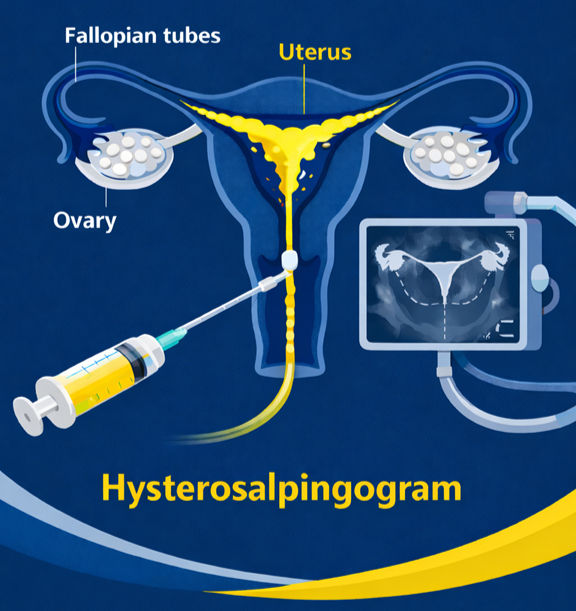
An HSG (hysterosalpingogram) is an X-ray test that allows us to check your fallopian tubes for any blockages or structural issues that might be affecting fertility. It also will give us information about the structure of your uterus.
Your uterus and fallopian tubes work together to support conception — the uterus is where a pregnancy implants and grows, while the fallopian tubes are the pathways where the egg and sperm meet. If either of the tubes are blocked or there are structural irregularities, it can make conception more difficult or block it all together.
The HSG provides a clear view of these areas, helping your physician decide what next steps — if any — are needed in your fertility plan.
🩺 When and How the Test Is Done
An HSG is typically scheduled between menstrual cycle days 5–11 (Cycle Day 1 is the first day of full flow menses), after your menstrual bleeding has stopped but before ovulation. This timing ensures there is no chance of pregnancy during the test.
Here’s what happens during the procedure:
You’ll arrive at our office for your appointment and check in as normal.
The test is done in our procedure room with your provider and an X-ray machine.
A small catheter (a soft, thin tube) is gently placed through the cervix into the uterus.
A contrast dye (a type of medical fluid that shows up clearly on X-ray) is slowly introduced through the catheter.
As the dye fills the uterus and moves through the fallopian tubes, X-ray images are taken in real time.
The dye allows your doctor to see the shape of your uterus and whether the tubes are open or blocked. The entire procedure usually takes less than 10 minutes.
💙 What You Might Feel
It’s normal to experience some mild cramping during or shortly after the HSG, similar to menstrual cramps. This happens as the uterus reacts to the dye and catheter placement.
Cramping usually lasts just a few minutes, and you’ll be able to return to normal activities the same day. We typically recommend taking an over-the-counter pain reliever like Tylenol or Ibuprofen about 30 minutes before your appointment (as long as you have no allergies to these medications).
Afterward, you might have light spotting or discharge for a few hours — both are completely normal.
🌸 What the HSG Tells Us
The HSG helps your physician assess:
Whether your fallopian tubes are open, blocked, scarred or dilated.
Whether your uterine cavity has any structural irregularities.
How the dye flows, giving insight into tubal and uterine function.
This information is key to understanding your unique fertility picture.If the results look completely normal, that’s great news! If an issue is found, it doesn’t mean you’re “infertile” — it simply gives us helpful information so we can tailor your next steps.
💬 After Your HSG
Your STL Fertility provider will review your HSG images and results with you, explaining what they show in clear and compassionate language. You’ll always have a chance to ask questions and discuss what comes next.
Our goal is for every patient to walk out of testing feeling informed, reassured, and cared for — never rushed or unsure.
💜 A Message from STL Fertility
Fertility testing can naturally bring up questions, emotions, and even a bit of anxiety — and that’s okay. At STL Fertility, we believe that knowledge is empowering. The more you understand what each test means and why we do it, the more at ease you’ll feel throughout your journey.
The HSG is just one piece of the diagnostic puzzle — but together, these early steps help us create a care plan as unique as you are. You are never just a number here; you’re part of the STL Fertility family. 🌿


Comments