

Our IVF Success Rates
74%
First-time patient success, under 35
100%
Singleton births for patients under 40
1.8%
Cancellation rate,
under 35 (national avg: 3.8%)
Source: 2023 Final SART Clinic Summary Report — independently verified
A comparison of clinic success rates may not be meaningful because patient medical
characteristics, treatment approaches, and entry criteria for ART may vary from clinic to
clinic. Visit SART.org to learn more.
First Time Patient Success Rates
For patients starting their very first IVF cycle at STL Fertility, the outcomes are exceptional. STL Fertility exceeded the national average in every age group under 41. The 41–42 group is shown for full transparency; the smaller sample size (n=9) means this figure carries wider statistical uncertainty.

Source: 2023 Final SART Clinic Summary Report — independently verified
Your Chance of Having A Baby - All Embryo Transfers
This is the most complete success metric: it counts all live births from any transfer linked to a retrieval cycle, divided by all patients who started treatment — regardless of how many transfers were needed. STL Fertility exceeded the national average in every age group under 41. The 41–42 group is shown for full transparency; the smaller sample size (n=20) means this figure carries wider statistical uncertainty.
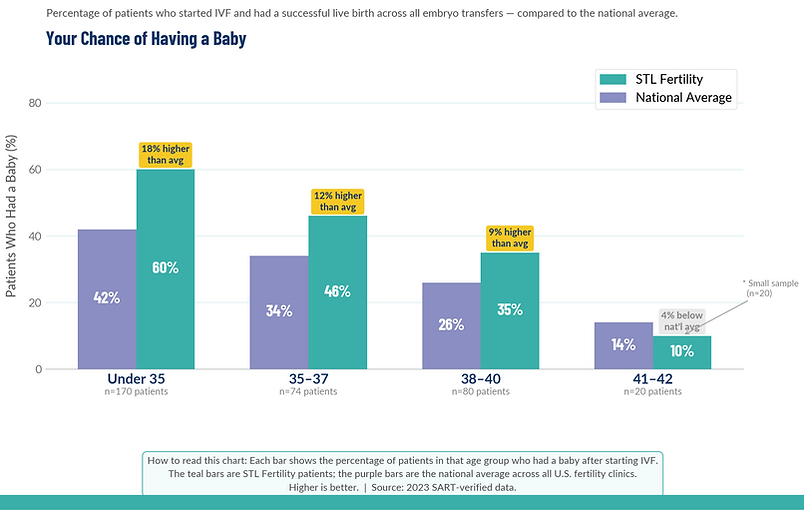
pp = percentage points above national average. National average = all SART member clinics, 2023.
Source: 2023 Final SART Clinic Summary Report — independently verified
One Healthy Baby at a Time
Twin and triplet pregnancies carry significantly higher risks for both mother and babies — including premature birth and NICU stays. STL Fertility's elective single embryo transfer (eSET) policy means virtually all live births are healthy singleton pregnancies.

Source: 2023 Final SART Clinic Summary Report — independently verified
Fewer Cancelled Cycles. More Retrievals Completed.
A cancelled cycle means the stimulation was stopped before egg retrieval — costing time, money, and emotional energy. STL Fertility's cancellation rate is less than half the national average, reflecting careful patient management and protocol precision.

Source: 2023 Final SART Clinic Summary Report — independently verified
THE STL FERTILITY APPROACH
How We Define Success
The Society for Assisted Reproductive Technology (SART) is a collective third-party agency that analyzes and reports on key data points such as pregnancy and live birth rates for assisted reproductive technology procedures. This data provides patients, clinics, and researchers with transparency and insights into the performance of fertility clinics nationwide.
Why This Matters
Access to SART data empowers patients to take control of their fertility journey with the ability to see third-party validated statistics to help inform decisions, prepare questions, and set expectations as they consider fertility treatment options. We strongly recommend patients only consider clinics which report to SART to ensure success rates are properly validated.
Raising the Bar for Better Patient Success
We are proud to achieve third-party validated success rates that exceed both regional and national benchmarks across the majority of patient age groups. A comparison of clinic success rates may not be meaningful because patient medical characteristics, treatment approaches, and entry criteria for ART may vary from clinic to clinic. Visit SART.org to learn more.
Why Our Success Rates Are Significant
We believe that as long as our patients understand the journey ahead, they have the right to pursue parenthood, and we are here to champion them throughout that journey. We choose to lead with compassion and prioritize our patients’ dreams of parenthood. A comparison of clinic success rates may not be meaningful because patient medical characteristics, treatment approaches, and entry criteria for ART may vary from clinic to clinic.